A souvenir from Rausu reveals the connections between biology and place
On a recent trip to Hokkaido, I bought some kombu to take home. At first, I rather casually assumed that kombu would taste much the same wherever it came from. Back home, however, I tried the Rausu kombu—prized for its limited availability—in my usual cooking, and it took me by surprise. When I tasted the dashi, it was quite unlike the stock I made with the kombu I normally bought at the supermarket. That was when my curiosity about kombu really began.
Look at a display of kombu and you will see place names from across Hokkaido: Rishiri, Rausu and Hidaka. It is easy to assume that these are simply regional versions of the same seaweed. Differences in water temperature, currents and nutrients, together with the producers’ drying and storage practices, seem a perfectly reasonable explanation for their distinctive flavors.
Even the same rice cultivar, Koshihikari, can give a different impression when grown in Uonuma rather than elsewhere in Tohoku or Kyushu. Should we think of kombu in the same way—as the same organism expressing the character of the place where it grows?
There is, however, something this explanation overlooks. The place names on kombu packages can also conceal biological differences. Rausu kombu is oni-kombu, while Hidaka kombu is mitsuishi-kombu. Both products bear geographical names, but they are not simply the same kombu grown in different seas. [1, 2]
With cabbages and grapes, we readily accept that cultivars differ in sweetness, aroma and texture. We should bring a similar curiosity to kombu, while keeping one distinction in mind: the differences discussed here are mainly between species and botanical varieties, rather than cultivated varieties deliberately developed by people.
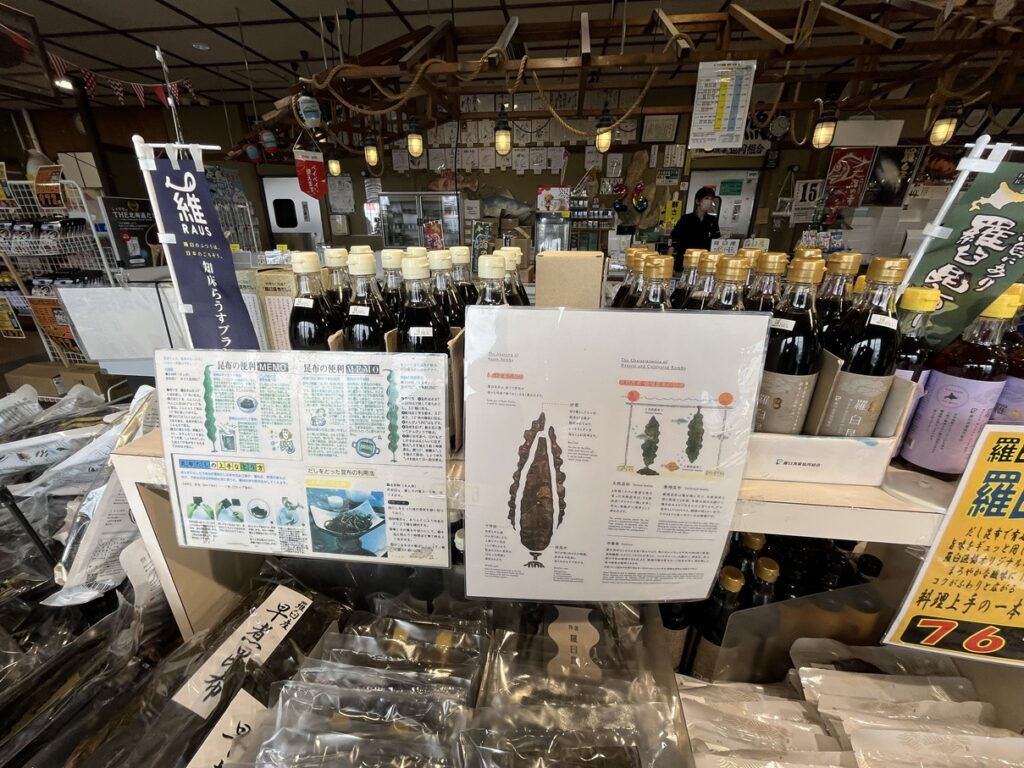
Photo 1. Rausu kombu purchased at the Michi-no-Eki roadside station in Rausu.
The Organisms Behind the Product Names
The following table links familiar commercial names to Japanese biological names and scientific names. The taxonomy follows the treatments used by the National Museum of Nature and Science and JAMSTEC. [1–4]
| Commercial name | Japanese biological name | Scientific name | Main production areas |
| Ma-kombu | Ma-kombu | S. japonica var. japonica | Hakodate and southern Hokkaido |
| Rishiri kombu | Rishiri-kombu | S. japonica var. ochotensis | Rishiri, Rebun and Wakkanai coasts |
| Rausu kombu | Oni-kombu | S. japonica var. diabolica | Rausu coast |
| Hosome kombu | Hosome-kombu | S. japonica var. religiosa | Hokkaido’s Japan Sea coast |
| Hidaka / Mitsuishi kombu | Mitsuishi-kombu | S. angustata | Hidaka coast |
| Naga / Hamanaka kombu | Naga-kombu | S. longissima | Kushiro–Nemuro coast |
| Atsuba kombu | Gaggara-kombu | S. coriacea | Kushiro–Nemuro coast |
| Gagome kombu | Gagome-kombu | S. sculpera | Hakodate area |
S. abbreviates Saccharina. The abbreviation var. denotes a botanical variety, not a human-developed cultivar.
In this classification, ma-kombu, rishiri-kombu, oni-kombu and hosome-kombu belong to the same species, Saccharina japonica, with distinctions recognized below the species level. Mitsuishi-kombu and naga-kombu are separate species. Older publications may treat the former groups as separate species and use the previous genus name Laminaria. [2, 4]
Other product names describe something different. Saomae kombu refers to early harvesting, while tororo kombu and oboro kombu are processed products. A name on a package does not always identify a biological kind. [3]
How Biology Becomes Flavor
One of the principal sources of kombu’s umami is free glutamate. Analyses comparing kombu samples have found differences in its concentration. Mannitol, a mildly sweet sugar alcohol, also contributes to taste. What we experience as flavor is a combination of umami, sweetness, aroma and the sensations that linger in the mouth. [5, 6]
Commercial descriptions characterize ma-kombu as producing a clear dashi with a refined sweetness; Rishiri kombu as yielding a clear, flavorful stock; and Rausu kombu as giving a more aromatic, rich and full-bodied dashi. Hidaka kombu softens readily, making it suitable for kombu rolls and dishes such as oden. The differences extend beyond the taste of the stock to the texture of the seaweed itself and its suitability for different cooking methods. [3]
Biological identity does not determine everything. Kombu growth responds to water temperature, light, nutrients and water movement. Even samples of the same biological kind are not directly comparable if they grew under different conditions or were harvested at different times. Drying and storage history also need to be considered, as do the amount of kombu used, the water, and the temperature and duration of extraction. [3, 7]
The question is therefore not a simple choice between biological identity and geographical origin. The characteristics of a species or variety interact with growing conditions, post-harvest handling and cooking. Comparing a packet of Rausu kombu with a packet of Hidaka kombu cannot tell us what proportion of the flavor difference comes from biology and what proportion comes from the environment.
The same caution applies to my own discovery. Without checking the biological identity and grade of the kombu I normally used, I cannot attribute the difference I tasted to a single cause. Yet adding “What organism is this?” to “Where was it harvested?” takes our understanding a step further. A bag of kombu brought home from a journey became an introduction to the diversity of Hokkaido’s seas.
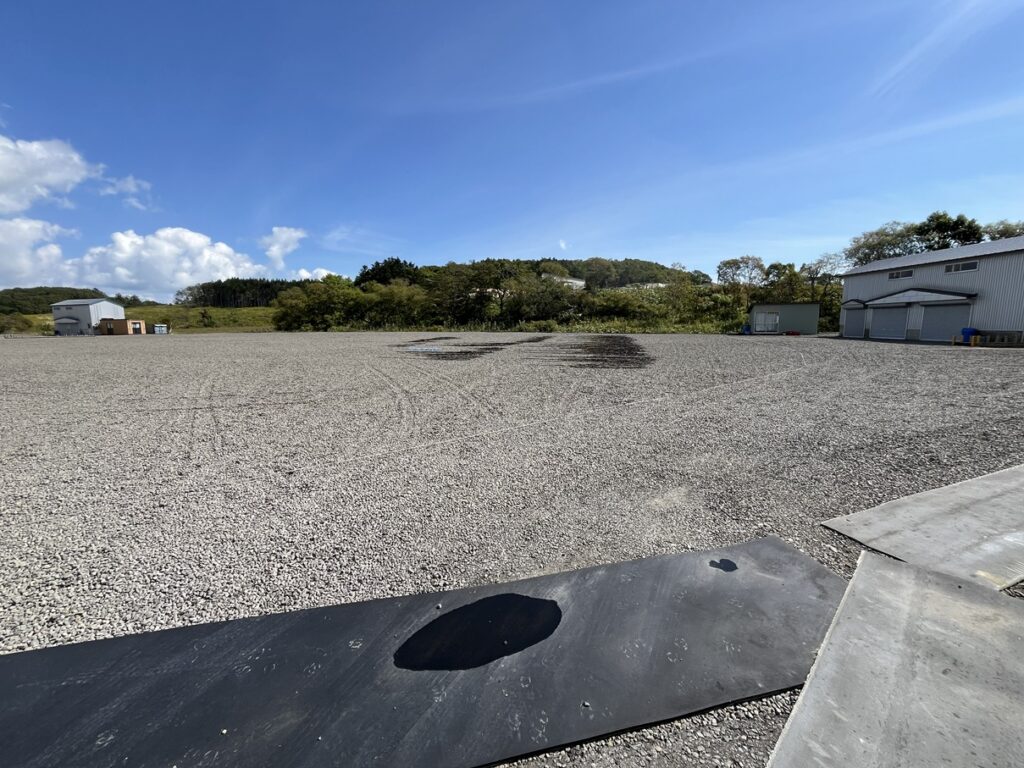
Photo 2. At first glance, this kombu drying ground looks like a temporary outdoor parking lot. Senposhi, Kushiro Town, Hokkaido.
Kombu Around Hokkaido
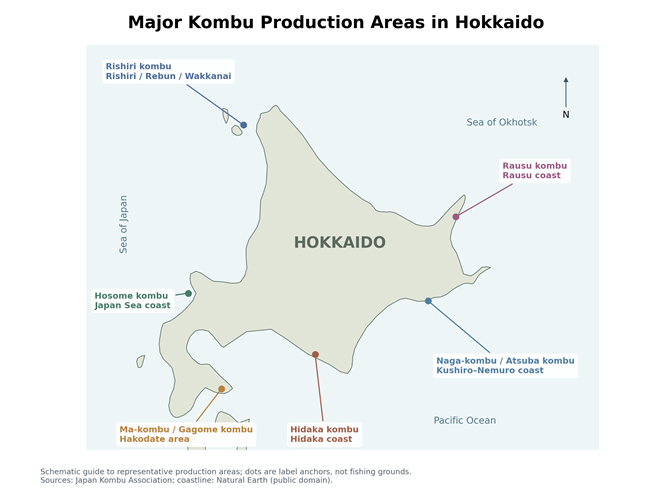
Figure 3. Major kombu production areas in Hokkaido. This schematic shows representative areas rather than precise distribution boundaries. Several kinds may occur within the same region.
The labels use commercial names, which can combine a biological identity with a geographical origin. Ma-kombu and gagome kombu share the Hakodate area; naga-kombu and atsuba kombu are both produced along the Kushiro–Nemuro coast. [1, 3]
Map sources: production-area descriptions from the Japan Kombu Association; coastline from Natural Earth, 1:50 million, public domain. Original schematic prepared for this article.
References
[1] N. Yotsukura. Introducing Hokkaido kombu to the world (Part 1). In Japanese.
https://nori.or.jp/essay/essay_029-001.html
[2] National Museum of Nature and Science. The Seaweed World of Japan: Laminariales. In Japanese.
https://www.kahaku.go.jp/research/database/seaweedworld/html/kaisou-list/konbu-list.html
[3] Japan Kombu Association. Types of kombu. In Japanese.
https://kombu.or.jp/power/shurui
[4] JAMSTEC BISMaL. Saccharina japonica var. japonica.
https://www.godac.jamstec.go.jp/bismal/j/view/9020268
[5] Free amino acid content of kombu and its effects on ramen soup flavor. 2008 conference abstract. In Japanese.
https://www.jstage.jst.go.jp/article/ajscs/20/0/20_0_188/_article/-char/ja/
[6] Umami Information Center. Frequently asked questions. In Japanese.
https://www.umamiinfo.jp/faqs/
[7] Hokkaido Research Organization. On kombu growth. In Japanese.
https://www.hro.or.jp/fisheries/publication/ima/o7u1kr0000002iui.html
[8] Natural Earth. Public-domain map data.
https://www.naturalearthdata.com/