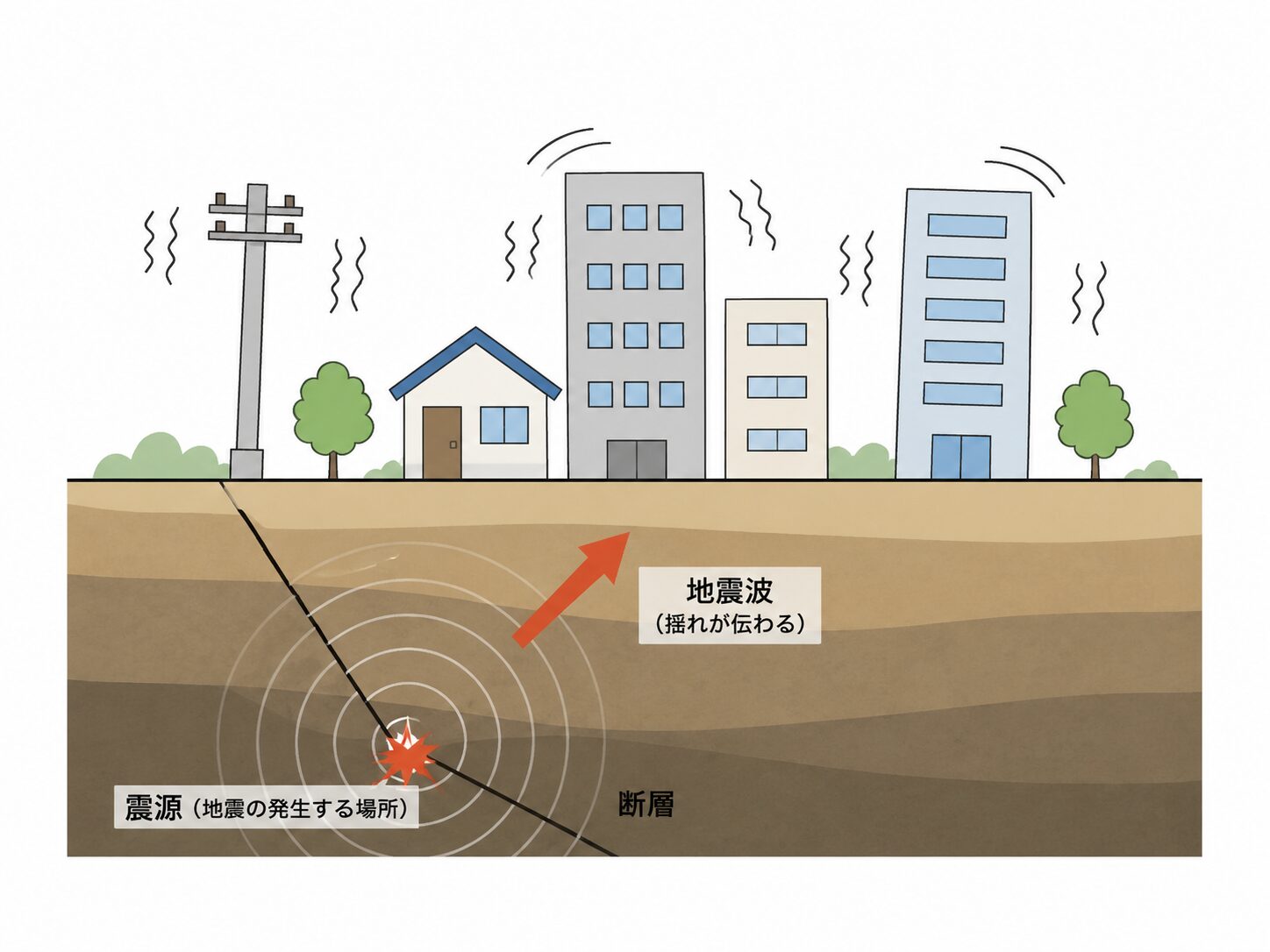
Long-Period Ground Motion: A Different Face of Earthquakes
The 2026 Kumamoto Earthquake once again demonstrated that earthquakes are not composed of a single type of shaking. Long-period ground motion was observed during this event, reminding us that destructive seismic effects are not limited to the short, violent shaking that most people associate with earthquakes. A similar phenomenon was also documented during the foreshock of the 2016 Kumamoto Earthquake, confirming that long-period motion is an important characteristic of major inland earthquakes in Kyushu.
Long-period ground motion refers to seismic waves with relatively long oscillation periods, typically between about 2 and 10 seconds or even longer. These slow, rolling motions are particularly effective at exciting large, flexible structures whose natural vibration periods are similarly long. High-rise buildings, long-span bridges, oil storage tanks, and tall chimneys are therefore much more susceptible than ordinary low-rise houses.
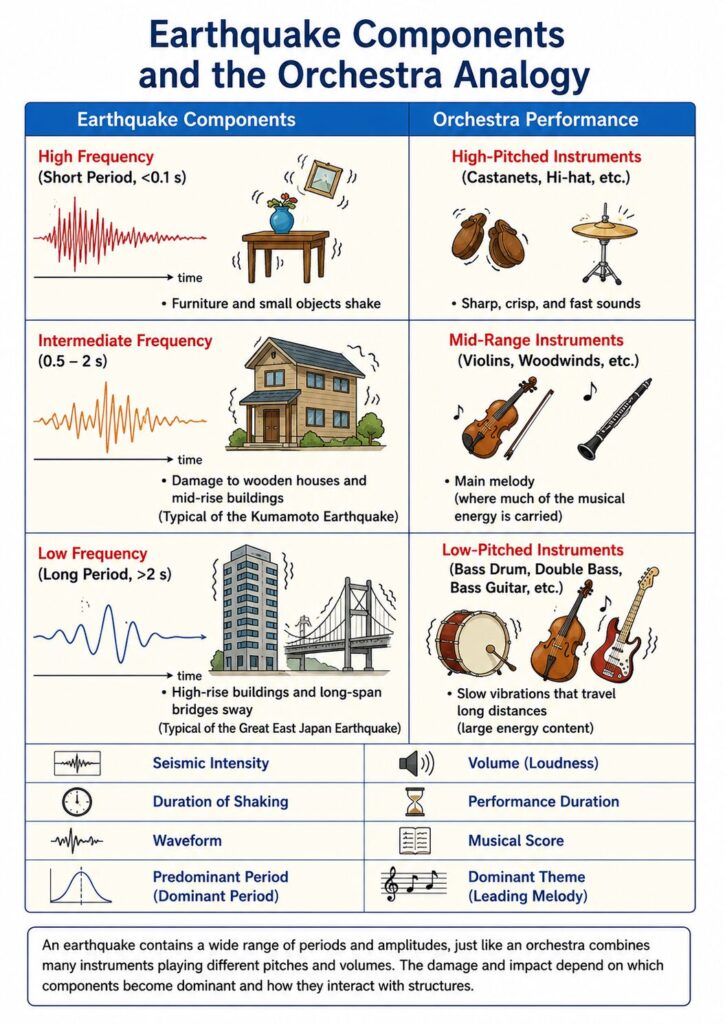
To understand this phenomenon, it is important to recognize that an earthquake is not a single vibration. Every earthquake produces a broad spectrum of seismic waves with many different periods, frequencies, and amplitudes. An earthquake resembles an orchestra rather than a single musical note. Just as an orchestra combines the sounds of many instruments playing different pitches and volumes simultaneously, an earthquake contains numerous wave components with different wavelengths and strengths. The shaking experienced at any location depends on which of these components become dominant.
Ordinary earthquakes are generally characterized by high-frequency, short-period shaking that strongly affects small and stiff structures such as detached houses. In contrast, long-period ground motion consists of slower oscillations that travel efficiently over great distances and strongly excite tall, slender, and flexible structures. Consequently, buildings located hundreds of kilometers from the epicenter may experience prolonged swaying even when the local seismic intensity is relatively low.
The Japan Meteorological Agency classifies long-period ground motion into four intensity classes (Class 1 to Class 4) according to its expected impact on people and large structures. These classes provide practical information for evaluating potential hazards inside high-rise buildings, where prolonged swaying can make standing difficult, move furniture, and disrupt elevators even without severe structural damage.
Unlike the primary (P) and secondary (S) body waves that travel through the Earth’s interior, long-period ground motion is closely associated with surface waves, particularly Love and Rayleigh waves. Surface waves propagate along the Earth’s surface and often become amplified in thick sedimentary basins, allowing them to travel long distances while retaining significant energy. Because of their long wavelengths and extended duration, they can continue shaking large structures long after the strongest body-wave motions have passed.
Understanding long-period ground motion reminds us that earthquakes should not be viewed as a single type of vibration. Instead, every earthquake is a complex combination of many wave components with different periods, wavelengths, and amplitudes. The damage produced by an earthquake depends not only on its magnitude but also on how these wave components interact with the natural vibration characteristics of individual structures.