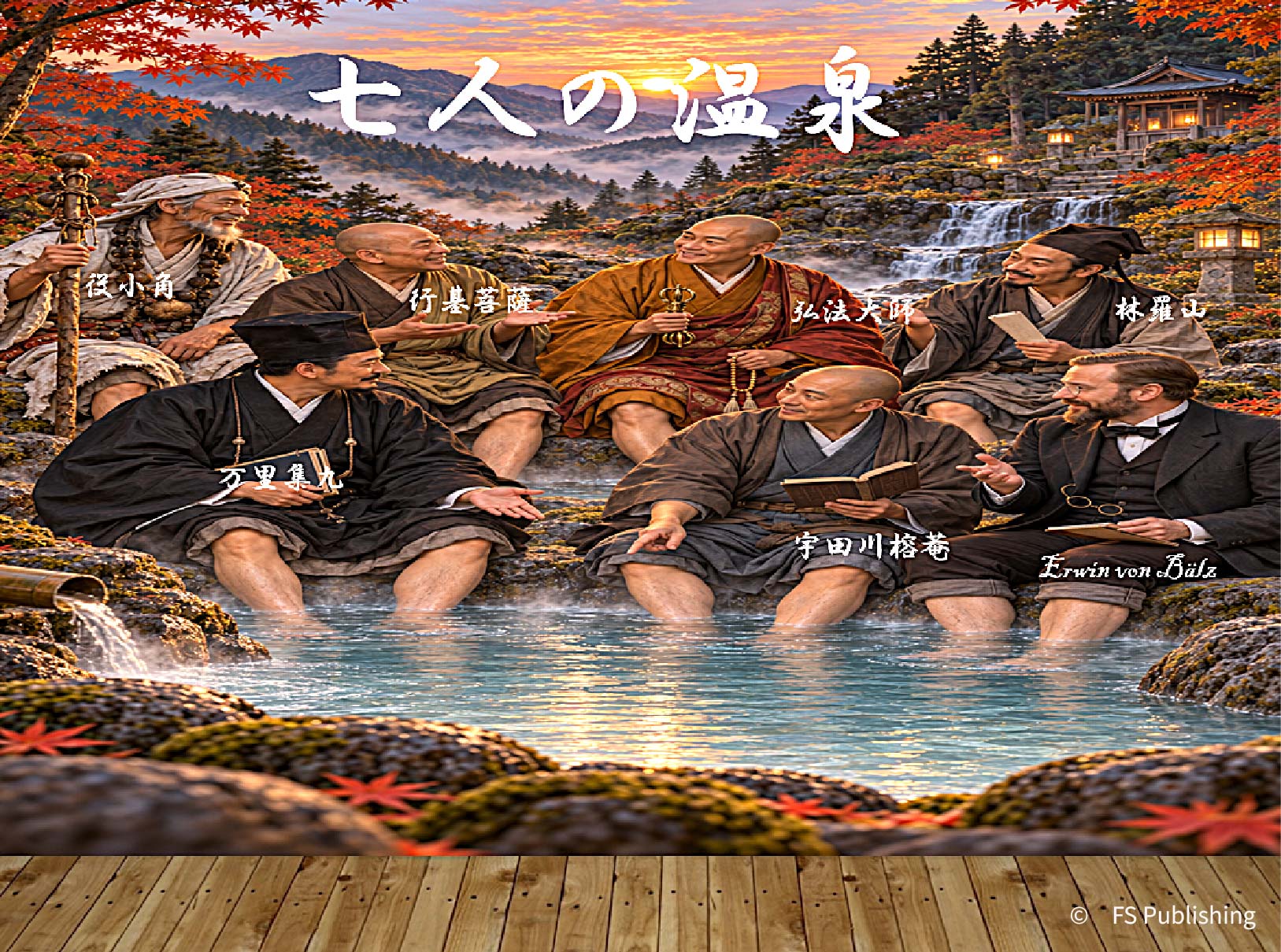
Japan’s Onsen Culture
In Japan, keeping oneself and one’s surroundings clean is deeply rooted in everyday life. Cleanliness also has a spiritual dimension. In misogi, for example, the body is cleansed with water as a way of dispelling spiritual impurity. From bathing in hot springs to using today’s electronic bidet toilets, washing with water has a lasting place in Japanese life. As I explore the development of Japan’s hot spring culture, I have come to wonder whether one Buddhist scripture helped shape it: a text presenting a dialogue between the Buddha and the physician Jīvaka, known in Japanese as Giiki.
The text is the Bussetsu Onshitsu Sen’yoku Shusō Kyō, which I will call the Bathhouse Sutra. Its title may be rendered in English as The Sutra Spoken by the Buddha on Bathing the Community of Monks in a Bathhouse. This short Chinese text, approximately 1,300 characters long, is traditionally attributed to An Shigao, a translator active in the second century CE during the Later Han dynasty. That attribution is disputed, however. We should also distinguish the period in which the narrative is set—the Buddha’s lifetime—from the date when the surviving text took shape.
The sutra teaches that bathing with seven supplies, known as the “seven items,” removes “seven ailments,” and that providing baths for monks brings “seven blessings.” Washing the body, cleaning the mouth and teeth, and keeping clothing clean are all relevant to maintaining health. A distinctive feature of the text is that it also treats giving others the opportunity to bathe as an act of religious merit.
During the Asuka and Nara periods, Japan worked toward a centralized state while adopting institutions and knowledge from Sui and Tang China. Buddhism was valued as a foundation for the stability of the state, and temples and monks undertook scholarly, medical, and charitable work alongside religious activities. The Bathhouse Sutra reached Japan within this wider Buddhist culture. According to the Nara National Research Institute for Cultural Properties, a record survives of the sutra being copied in Japan in 736 CE. Its teachings were therefore being transmitted in Japan by at least the eighth century.
Across Japan, local traditions attribute the discovery or opening of hot springs to monks some 1,200 to 1,300 years ago. This overlaps with the period when Buddhism was becoming firmly established in Japan. The dates given in such legends cannot, by themselves, establish when bathing facilities were founded or demonstrate the influence of a particular scripture. Nevertheless, the halls dedicated to Yakushi, the Medicine Buddha, that one encounters in hot spring towns offer clues to the connection between therapeutic bathing and Buddhist faith.
Reading the Bathhouse Sutra, I am struck by the way it brings bodily cleanliness, everyday health, and generosity toward others into a single teaching. It is not a health manual whose claims have been tested by modern medicine. Yet it contains ancient insights that still speak to our concerns about hygiene and health. Below, I introduce an English translation of the sutra prepared with the assistance of AI. I hope to share with you something of how people in antiquity understood bathing and health.
Perhaps reflecting on that ancient wisdom while soaking in an outdoor hot spring bath is a pleasure in its own right.
We cannot conclude that the Bathhouse Sutra directly sparked a boom in Japanese hot spring bathing. Its subject is bathing and the merit of providing baths, rather than natural hot springs specifically. Still, I believe that the establishment of bathing facilities at temples and the practice of offering baths to others may have helped spread the idea that cleanliness and health belong together.
©FS Publishing
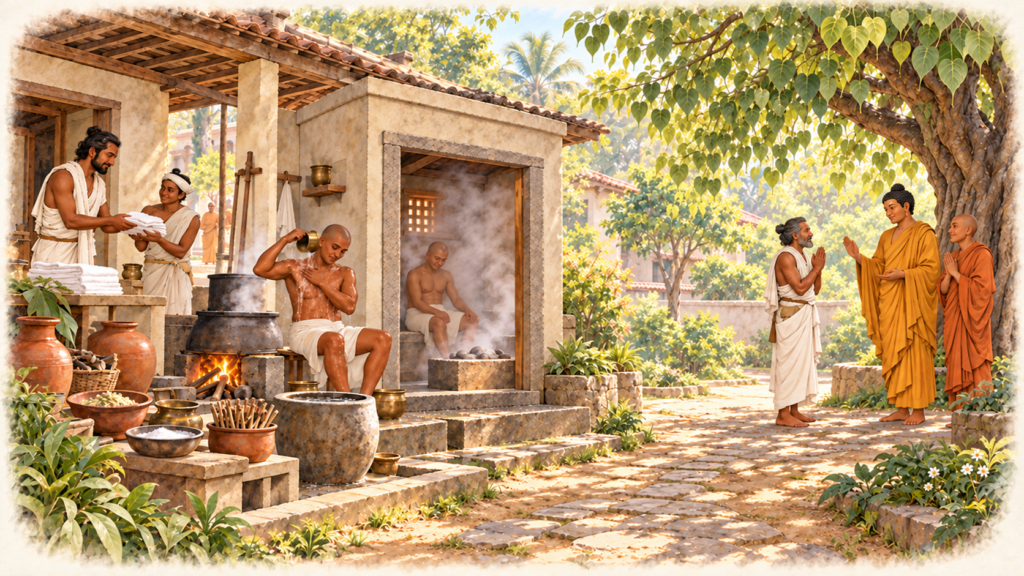
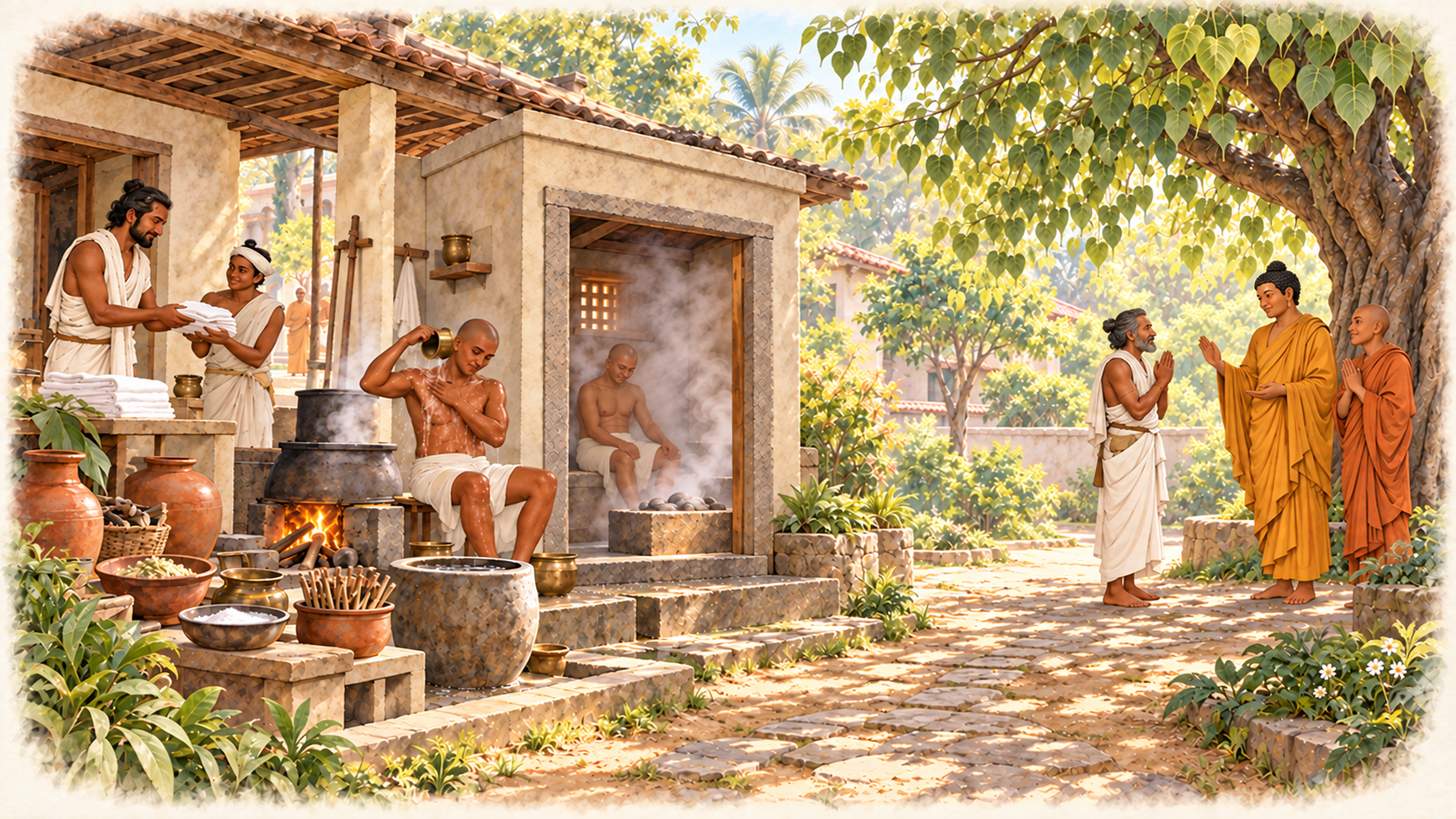
An imagined scene inspired by the Warm Bath Sutra: monks wash and enjoy a steam bath while the physician Jīvaka speaks with the Buddha beneath a Bodhi tree. The illustration expresses the sutra’s message of cleanliness, care for others, and the merit of providing bathing facilities. Created with AI; not a historical reconstruction.
The Buddha’s Teaching on Bathing the Community of Monks
A complete translation in plain English dialogue
Traditionally attributed to An Shigao of Parthia during the Later Han dynasty.
The opening story
Ananda: This is what I heard from the Buddha.
Once, the Buddha was staying on Mount Yinshajue in the kingdom of Magadha. In the city of Rajagriha lived a respected man named Jivaka, the son of the woman Amrapali. He was a great physician who treated many illnesses. From childhood, he loved learning. He was highly skilled in many arts and understood the five classics, astronomy, and geography. Everyone he treated recovered. Even those who had died came back to life, and people being carried away for burial returned home. His good deeds were too many to describe. People in eight kingdoms looked up to him, and everyone was happy to see him.
Narrator: One night, Jivaka suddenly thought, “Tomorrow I will visit the Buddha and ask him about the questions in my mind.”
At dawn, he told everyone in his household to get ready. Together, they went to see the Buddha. At the entrance to the monastery, they saw him shining brightly, his light reaching across heaven and earth. An immense crowd of monks, nuns, laymen, and laywomen sat around him. The Buddha was teaching, and everyone listened quietly with full attention. Jivaka and his household stepped down from their carriage, went forward, bowed to the Buddha, and sat to one side.
Buddha: Welcome, great physician. If there is something you would like to ask, please do not hesitate.
Narrator: Jivaka knelt before the Buddha and spoke.
Jivaka: Although I have been born into this world as a human being, I have lived without much understanding. I have followed ordinary worldly ways and have not yet done deeds that bring spiritual merit.
Now I would like to invite you, the community of monks, and the great bodhisattvas to bathe in a bathhouse. May all living beings remain clean through the long night of suffering. May their dirt and impurities be washed away, and may they be free from many troubles. Please, in your wisdom, accept my wish.
Buddha: Excellent! What a good wish. You treat people’s illnesses and help them recover. People near and far are grateful and happy.
Now you also wish to invite me and the monks to bathe in a bathhouse. You wish this benefit to reach beings everywhere. Treating illness with medicines and washing away dirt through bathing bring immeasurable merit.
Listen carefully. First, I will tell you about the blessings that come from providing baths for the monks.
The seven items and their blessings
Buddha: For bathing, use seven items. These remove seven ailments and bring seven blessings.
What are the seven items?
1. A fire to heat the bath.
2. Clean water.
3. Beans or bean powder for washing.
4. A butter-based ointment.
5. Clean ash for cleansing.
6. A twig for cleaning the teeth.
7. A garment to wear while bathing.
These are the supplies used for bathing.
Buddha: What are the seven ailments that bathing removes?
1. It brings the body’s four elements into a peaceful, balanced state.
2. It removes illnesses caused by wind.
3. It removes stiffness and numbness caused by dampness.
4. It removes severe cold and chill.
5. It removes excessive heat.
6. It removes dirt and impurity.
7. It makes the body light and comfortable, and the eyes clear and bright.
These are the seven ways it relieves the monks’ ailments.
Buddha: By making this offering, you receive seven blessings. What are they?
1. Wherever you are born, the body’s four elements are free from illness. You are safe, strong, brave, and healthy, and people respect you.
2. Wherever you are born, you are clean and have a pleasing face. Dust and dirty water do not cling to you, and people respect you.
3. Your body always smells pleasant, and your clothes are clean. People are happy to see you and treat you with respect.
4. Your skin is soft and moist. Your presence is radiant and your virtue great. Everyone respects and admires you, and you stand without equal.
5. You have many attendants who brush away dust and dirt for you. Blessings come to you naturally, and you remember your past lives.
6. Your mouth and teeth are fresh and pleasant. Your teeth are white, well shaped, and even. People respectfully follow your words and instructions.
7. Wherever you are born, beautiful clothes and precious ornaments come to you naturally. Those who see you are filled with awe.
Buddha: Jivaka, these are the seven blessings of providing baths for monks and bodhisattvas.
Through this deed, you may become a minister or a ruler. You may become a deity of the sun or moon, or one of the Four Heavenly Kings. You may become Shakra, king of the gods, or a universal monarch. You may be born in Brahma’s heaven and receive blessings beyond measure. Or you may become a bodhisattva, resolve to uphold the stages of the path, complete your practice, fulfill your aim, and finally become a Buddha.
Offering support to the monks is like planting in a field that produces endless blessings. Neither drought nor flood can harm that field.
Narrator: Then the Buddha spoke again to Jivaka in verse.
The Buddha’s verses
Buddha in verse: Look throughout the three realms of existence.
Gods and humans receive great blessings.
The goodness of the path has no limit.
Listen carefully as I explain.
Buddha in verse: A person is born with a pleasing appearance,
And other people respect them.
Their body and nature remain clean.
This comes from providing baths for monks.
Buddha in verse: If someone is born as the child of a high minister,
They have wealth, good fortune, and safety.
They are brave, strong, loyal, wise, and kind.
They can come and go without obstacles.
People follow what they say.
Their body is always fresh and clean.
They have a pleasing face and a calm manner.
This comes from providing baths for monks.
Buddha in verse: If someone is born into the family of a heavenly king,
They are clean from the moment of birth.
They bathe in fragrant water
And perfume their body with sweet scents.
Their appearance stands out from the crowd.
Everyone is happy to see them.
These are the blessings of building a bathhouse
And providing baths for monks.
Buddha in verse: In the first heaven, the Four Heavenly Kings
Rule over the four directions.
Their bodies are radiant and well formed.
Their power and virtue protect the four regions.
The sun, moon, and stars
Shine and drive away darkness.
This comes from providing baths for monks.
The blessings follow as surely as a shadow or an echo.
Buddha in verse: In the second heaven, the Heaven of the Thirty-three,
The king is Shakra, also called Indra.
His precious city has six surrounding walls,
And his palace is made of seven treasures.
He is mighty and honored among the gods,
With a pleasing appearance and a long life.
This comes from providing baths for monks.
These rewards have no equal.
Buddha in verse: In the human world, a universal monarch
Is led by the seven treasures.
He travels throughout the lands beyond the four seas,
With eighty-four thousand troops and horses.
A shining jewel gives light by day and night.
A beautiful woman attends to his needs.
His body is well formed, fragrant, and clean.
This comes from providing baths for monks.
Buddha in verse: In the sixth heaven of the realm of desire,
Its ruler holds the highest place.
He has all the radiant marks of a heavenly being.
His majestic power reaches through the six heavens.
Sweet heavenly food comes to him naturally,
And female entertainers are always beside him.
His many virtues are hard to put into words.
This comes from providing baths for monks.
Buddha in verse: In the heavens of Brahma,
Beings live in purity and cultivate their practice naturally.
Their conduct is clean and free from impurity,
And there are no female forms there.
They live a pure life and cleanse themselves,
With a sincere wish for nirvana.
To be born in those heavens
Comes from providing baths for monks.
Buddha in verse: The Buddha is honored throughout the three realms.
He practiced the path with great effort.
He built up good deeds over countless ages
And has now reached true awakening.
His golden body is adorned with jewels.
No dust or dirt clings to it.
He has a halo and all the marks of perfection.
This comes from providing baths for monks.
Buddha in verse: All Buddhas reach awakening through practice.
Their many deeds bring results without wasted effort.
Their gifts reach beings throughout the three realms.
No one is left outside their care.
The holy members of the monastic community,
Who follow the four stages of the path, are a rich field of blessings.
Goodness and the path grow from this field.
This practice is most wonderful and true.
Narrator: When the Buddha finished these verses, he spoke to Jivaka again.
The final teaching
Buddha: Look at the many kinds of humans and gods in the three realms. Some are high and some are low; some are tall and some are short. Some have great blessings and virtue, and others have little. These differences come from the different intentions and deeds of their past lives. That is why their present conditions are so different. The blessings I have described come from providing baths for the holy community.
Narrator: When the Buddha finished teaching, Ananda asked him a question.
Ananda: What should we call this sutra? How should we encourage people to follow it?
Buddha: Call it The Sutra on Bathing the Community of Monks in a Bathhouse. This teaching has been spoken by all Buddhas. I did not create it alone.
Those who put it into practice can cross beyond suffering. This freedom is not a gift bestowed by a god. If you seek the blessings of purity, you must practice it yourself.
Narrator: When the Buddha finished speaking, Jivaka and his household were delighted to hear the teaching. They all reached the first stage of awakening, known as stream-entry. They bowed to the Buddha, asked permission to leave, and prepared the bathing supplies.
Everyone in the gathering, great and small, made progress on the path. Together, they bowed their heads, paid respect to the Buddha, and departed.
Notes on the translation
The source is the supplied Chinese text of the Bussetsu Onshitsu Sen’yoku Shusō Kyō. The complete narrative, dialogue, lists, and verses are included. Speaker labels have been added to make the text easier to follow. The verses are translated as simple lines rather than as rhyming poetry.
The four elements, wind, dampness, heavenly realms, rebirth, and religious blessings are translated within the ancient text’s own view of the world. These are statements made by the sutra, rather than claims of modern medicine. “Bodhisattva” means a being who follows the path toward Buddhahood; “nirvana” means freedom from suffering and its causes.
The supplied text contains unusual old names for the mountain and certain heavens. “Mount Yinshajue” retains the mountain name as written instead of silently replacing it with a more familiar place name. The difficult expression 梵魔三鉢天 is rendered broadly as “the heavens of Brahma.” The phrase 發意持地 is expressed as resolving to uphold the stages of the path. These readings avoid a false degree of certainty.
The references to attendants, beautiful women, female entertainers, and the absence of female forms in Brahma’s heavens have been retained because they appear in the original.